
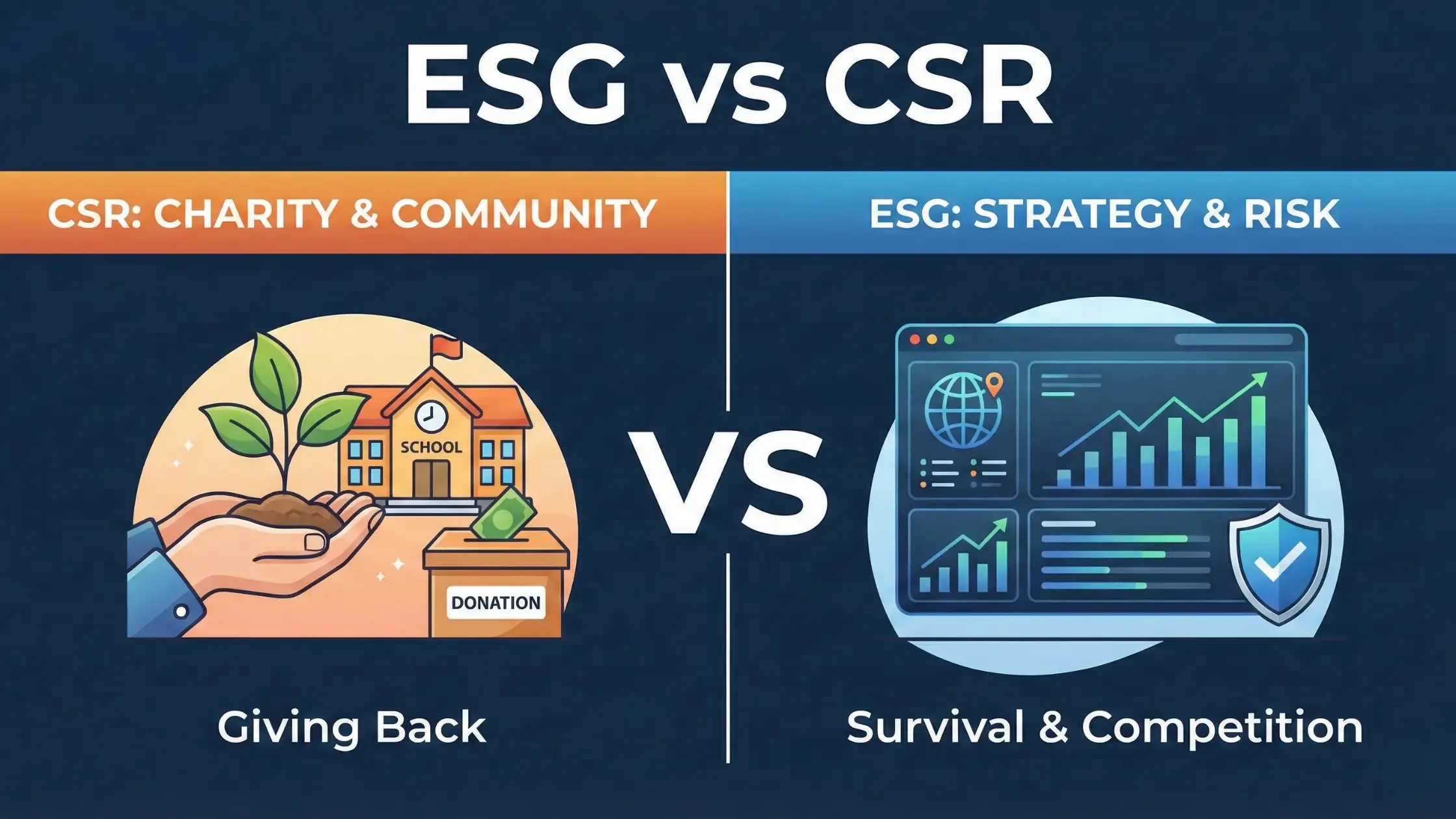
Introducton of ESG vs CSR
A few years ago, a mid-sized Indian manufacturer proudly walked into a board meeting with a new report, completely unaware of the looming ESG vs CSR crisis they were about to face. Specifically, they had built a school in their local district. Furthermore, they had run several successful health camps. Consequently, the company comfortably exceeded its statutory CSR spend under Section 135 of the Companies Act. Therefore, the board applauded the effort. However, six months later, the same company lost a massive supply contract with a German industrial buyer. Why did this happen? Primarily, their carbon emissions data lacked auditing. Additionally, their supplier due-diligence policy simply did not exist. Ultimately, their governance disclosures failed to meet the buyer's strict sustainability obligations. Indeed, the school was real, and the goodwill was genuine. Yet, goodwill obviously does not protect commercial contracts. Therefore, this scenario highlights the single most important confusion at the board level today: ESG vs CSR. Until boards understand the ESG vs CSR distinction, they will undoubtedly keep mistaking charity for strategic business resilience.
The Core of the ESG vs CSR Debate: What CSR Actually Is
To master the ESG vs CSR dynamic, you first need to define them separately. Essentially, Corporate Social Responsibility (CSR) represents your company’s conscience. Specifically, it acts outward. Moreover, it shows how you express your corporate values to the communities you touch. In India, naturally, the law gives CSR a highly specific definition. Under the Companies Act, 2013 (Section 135), specific large companies must absolutely spend at least 2% of their average net profits on eligible CSR activities. Consequently, a dedicated CSR Committee must formulate this policy and monitor its implementation. Furthermore, companies must strictly align these activities with Schedule VII of the Act. For instance, here is what CSR typically looks like in practice:
- Building schools, skill centers, or hospitals near factories.
- Providing scholarships to underprivileged youth.
- Contributing to disaster relief or clean water initiatives.
- Running health camps or rural development projects.
Importantly, we measure CSR primarily by outputs. First, how much money did the company deploy? Second, how many beneficiaries did the project serve? Finally, did the team complete the project on time? Indeed, these represent the exact right questions for CSR. Conversely, they are the wrong questions for ESG. Ultimately, CSR builds social license and strengthens community relationships. Without a doubt, it is highly valuable. However, it is never a substitute for governing your business sustainably. For a deeper dive, read our full guide on What is Corporate Social Responsibility? Why it is important for businesses?.
Why ESG Lives in a Different Universe
If you truly want to resolve the ESG vs CSR confusion, you must realize that ESG is certainly not a charity program. Instead, Environmental, Social, and Governance (ESG) operates strictly as a risk and performance framework. Specifically, you apply it directly to your core business operations. Furthermore, investors, lenders, regulators, and large customers use ESG data aggressively. Therefore, they want to know if your company manages risks well so they can safely make capital allocation and procurement decisions. Consequently, the three pillars function together as a unified system:
- Environmental (E): First, this covers your energy consumption, greenhouse gas emissions, water usage, and waste management. It is clearly not about planting trees for a photo opportunity. Rather, it asks if your business model can survive in a world facing resource scarcity and strict climate regulations.
- Social (S): Additionally, this involves labor practices, worker safety, diversity, and human rights across your supply chain. Currently, Indian boards show the most weakness in tracking the "S" pillar.
- Governance (G): Finally, this includes board independence, anti-corruption frameworks, whistle-blower mechanisms, and executive pay structures. Without independent oversight, your environmental and social claims immediately lose credibility with outside investors.
Unlike CSR, moreover, we measure ESG using strict quantitative indicators. Thus, you must set targets and track them year-over-year. Increasingly, external auditors must strictly verify these measurements rather than relying on self-reporting. To understand the basics better, check out What Are ESG Principles? A Beginner’s Guide.
ESG vs CSR: The Side-by-Side Framework Boards Need
Unfortunately, the ESG vs CSR confusion persists because boards rarely view the two concepts together. Therefore, here is the direct comparison that truly matters:
| Dimension | CSR | ESG |
|---|---|---|
| Core Question | How do we give back to society? | How do we manage material risks in our business model? |
| Primary Driver | Corporate values, ethics, and statutory obligations. | Investor demands, lender covenants, and regulatory mandates. |
| Scope | External projects directed at the community. | Core operations, supply chains, and board structures. |
| Time Horizon | Annual budget cycles. | Multi-year strategic capital planning. |
| Measurement | Money spent and beneficiaries served. | Emissions data, diversity ratios, and auditable governance scores. |
| Consequence of Failure | Reputational risk and regulatory penalties. | Lost contracts, higher capital costs, and investor exit. |
The Regulatory Reality Forcing the ESG vs CSR Shift
Currently, the stakes in the ESG vs CSR debate are no longer theoretical. Indeed, global and domestic regulations are tightening rapidly. Consequently, boards that try to pass off CSR spend as ESG readiness immediately face severe exposure.
India: SEBI BRSR Is Already Mandatory
Recently, the Securities and Exchange Board of India (SEBI) introduced the Business Responsibility and Sustainability Report (BRSR). Currently, the top 1,000 listed companies must absolutely file this mandatory report. Specifically, BRSR requires companies to disclose over 140 ESG data points. Furthermore, SEBI mandates third-party reasonable assurance for a focused subset called the BRSR Core. Obviously, this is not CSR. Instead, this represents heavily regulated, audited performance disclosure.
Europe: Pressure Coming Through Your Supply Chain
Similarly, if you work with European buyers or partners, your regulatory exposure increases dramatically. Specifically, the EU’s Corporate Sustainability Reporting Directive (CSRD) pushes strict ESG disclosure obligations deep into corporate supply chains. While Indian exporters avoid direct legal bounds, their EU buyers certainly do not. Therefore, these buyers absolutely demand sustainability data from Indian suppliers as a strict condition of doing business. Consequently, you cannot avoid this obvious conclusion: ESG now functions as basic trade infrastructure. Ultimately, failing at it costs you market access. For a stark example of what happens when governance collapses, review the IL&FS Governance Failure.
The Three-Bucket Framework Every Board Should Adopt
To definitively solve the ESG vs CSR problem, you must implement a structural fix inside your organization. First, stop putting them on the same presentation slide. Instead, create three explicit budget buckets with entirely different reporting lines.
- Bucket 1 — CSR Budget (Social Impact): Initially, this fulfills statutory obligations and supports local communities. The CSR Committee directly owns this bucket. Consequently, success means delivering projects and helping people.
- Bucket 2 — ESG Risk and Compliance Budget: Next, this establishes data systems, governance structures, and supplier oversight. The Risk and Compliance function strictly owns this bucket. Therefore, success means achieving regulatory compliance and protecting massive contracts.
- Bucket 3 — Sustainability CAPEX (Strategic Investment): Finally, this changes the fundamental economics of your business model. Ultimately, it helps you compete in a decarbonizing world. The CFO and Strategy team collaboratively own this bucket. Success means improving resource efficiency and securing a competitive market position.
Most importantly, you must enforce this strict separation. Therefore, never cite your CSR charity spend as evidence of your ESG progress.
Board-Level Questions That Create Accountability
Obviously, governance starts with asking the right questions. If your board only asks, "Did we meet our 2% CSR obligation?", you must immediately change the agenda. Therefore, consider these critical questions to properly align your ESG vs CSR strategy: On CSR:
- First, do we fully comply with Section 135?
- Second, do we actively document and disclose the actual impact of our projects, rather than just the money deployed?
- Specifically, what are our top five material ESG risks, and who owns each at the management level?
- Furthermore, do we have documented ESG due-diligence processes for our material suppliers?
- Ultimately, which capital projects will materially improve our emissions profile over the next three years?
- Additionally, do we treat supply-chain transformation as a strategic imperative or just a "nice to have" project?
Final Thoughts
In conclusion, many companies struggle with ESG because they mistakenly believe their CSR program already handles it. For instance, they point to a local skill center and instantly claim corporate responsibility. Indeed, they are completely right about their CSR impact. However, they are completely wrong about what ESG requires. Ultimately, your charity is not your strategy. Similarly, your philanthropy does not equal risk management. Therefore, you must definitively separate ESG vs CSR on your board agenda, in your budget, and in your public disclosures. CSR is how you give back. Conversely, ESG is how you survive and compete.