Introduction
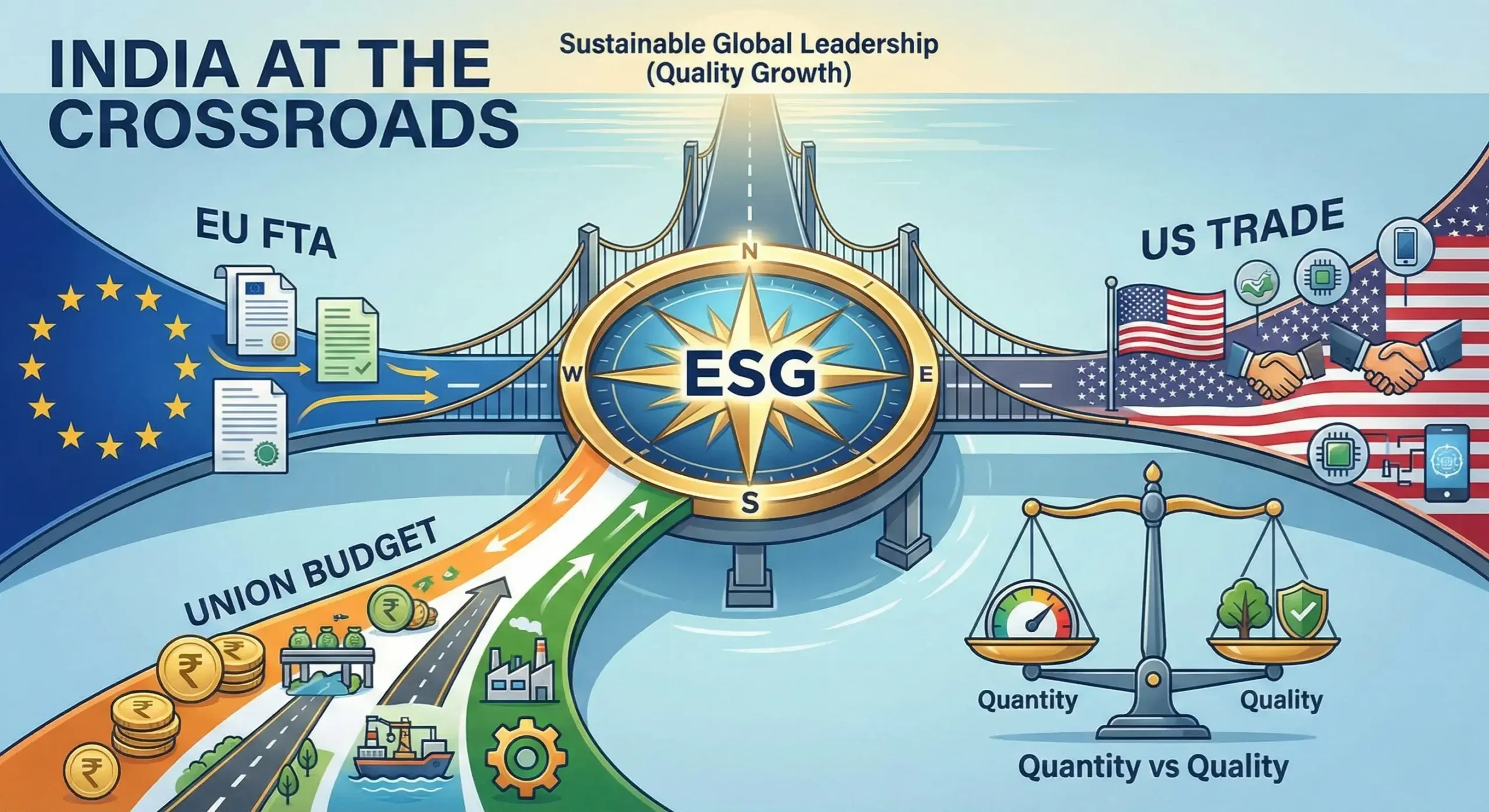
ESG in India trade policies are now the defining factor for the nation's economic future. Currently, India is juggling three massive forces: the ambitious Free Trade Agreement (FTA) negotiations with the European Union, a domestic Union Budget focused on infrastructure, and a deepening strategic partnership with the United States.
On the surface, these seem like separate issues. However, they are all connected by one critical thread: the urgent need for robust ESG (Environmental, Social, and Governance) standards.
Consequently, the challenge for India is no longer just about speed. The world is asking a tougher question: Is your growth sustainable?

1. ESG in India Trade & The EU FTA: Standards Over Tariffs
Historically, trade deals were simply about lowering tariffs to sell more goods. However, that era is over. The European Union has fundamentally changed its trade architecture. Furthermore, they are now exporting regulations, not just products. With mechanisms like the Carbon Border Adjustment Mechanism (CBAM), the EU is sending a clear message. Partners must align with their sustainability standards, or they cannot sell in the market. Therefore, compliance is mandatory. We have seen similar issues before. For example, the Aravalli crisis taught us that being "technically legal" is not enough. Modern business requires genuine stewardship, not just box-ticking.
The Bottom Line: For exporters in steel and textiles, the old strategy of cutting costs by ignoring rules is dead. adopting ESG in India trade strategies is the only way to remain competitive.
2. Union Budget Impact on ESG in India Trade
The latest Union Budgets have a clear focus: build big and build fast. We are seeing huge allocations for roads and ports. Undoubtedly, this drives the quantity of growth. But there is a mismatch. We are building assets faster than we are building the institutions to manage them. As a result, this creates a "governance gap." Global investors, such as sovereign wealth funds, look beyond headline GDP numbers. They seek risk-adjusted returns. They know that environmental non-compliance turns cheap capital into expensive liabilities. Thus, the Budget must answer: How durable is this growth?
3. US Relations: A New Era for ESG in India Trade
While the EU focuses on regulations, the United States focuses on strategy. The US wants to integrate India into critical supply chains like semiconductors and defense. However, access to these sectors is conditional. The US demands "governance maturity." This includes data protection and ethical labor practices. For Indian companies, ESG in India trade is not just a report; it is a trust credential. As we have discussed previously, ethical behavior in business is essential. It builds the long-term trust required for these partnerships.
4. The Bridge: Why ESG in India Trade Matters
ESG is often seen as something that slows business down. In reality, it disciplines business. It acts as the bridge between two types of growth:
- Quantity-Driven Growth: Focuses on speed, scale, and low cost.
- Quality-Driven Growth: Focuses on resilience and long-term value.
The Breakdown:
- Environmental: Ensures we don't destroy essential resources.
- Social: Prevents inequality and labor unrest.
- Governance: Ensures boards are accountable.
5. The Reality Check: The "Governance Gap"
Is India ready? The honest answer is: Partially. We have the talent and capital. Yet, our weak link is Governance Execution. Enforcement remains inconsistent. Too often, companies treat ESG in India trade compliance as a back-office task. To fix this, companies must adopt a robust corporate governance structure. This "Governance Gap" worries investors. We need to move beyond basic compliance. We must implement strategic solutions for corporate governance that address true accountability.
Conclusion
India’s moment is historic. Global supply chains are diversifying, and democracies need reliable partners. But success won't be judged by speed alone. The EU FTA, the Budget, and US ties are all testing us. Can we embed ESG in India trade frameworks to move from quantity-driven expansion to quality-driven leadership? ESG isn't the obstacle. It is the bridge. Is Indian industry ready to embrace ESG as a strategy? Let me know in the comments below.