
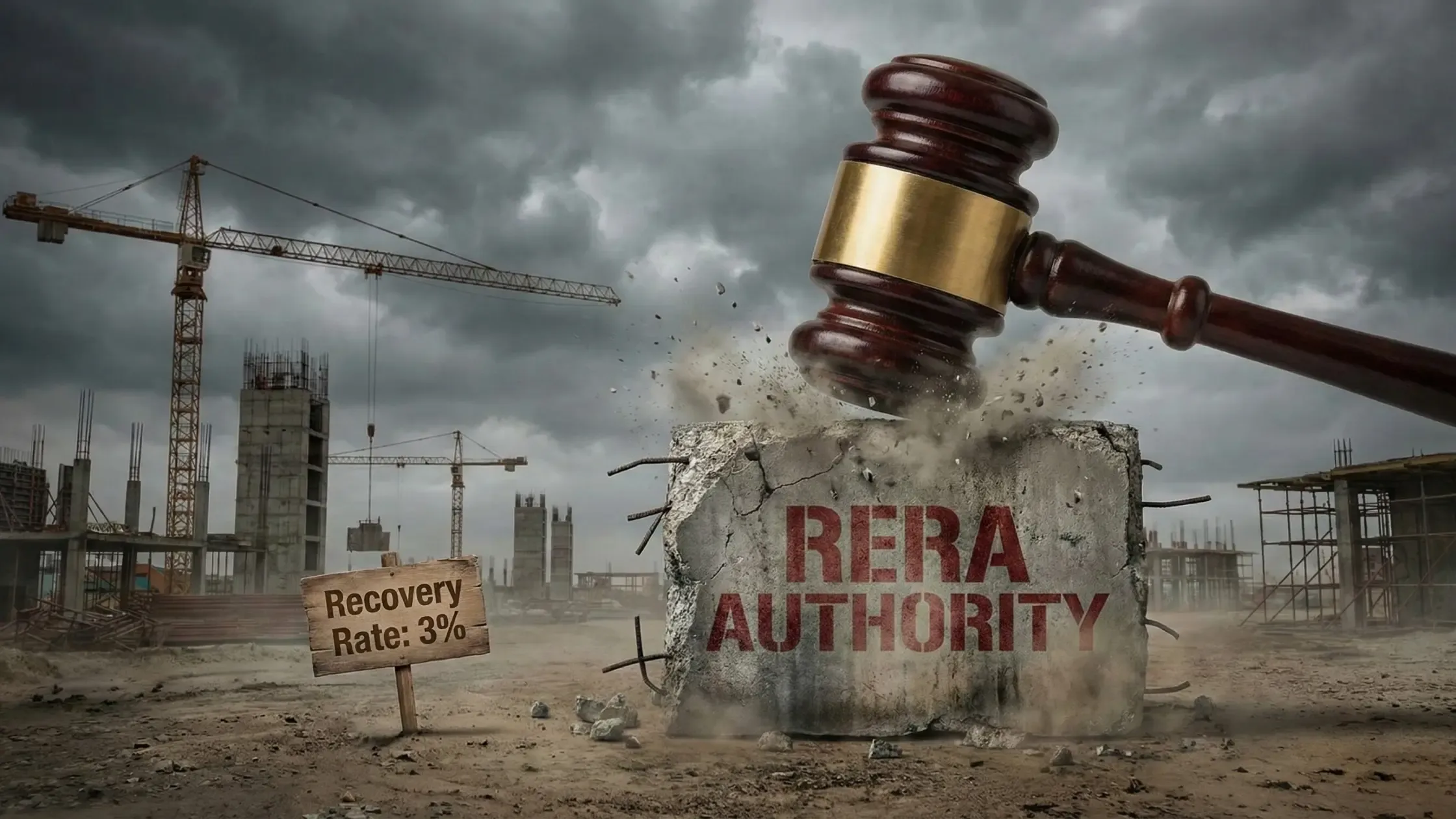
Introduction: The "Rehabilitation Centre" Verdict
The Real Estate (Regulation and Development) Act, 2016 (RERA) was conceived as a watershed moment for India's housing sector. For decades, the market was a "wild west," dominated by opaque practices, delayed projects, and helpless consumers. RERA was the promised sheriff—a specialized, quasi-judicial body designed to bring order, transparency, and accountability.
However, in February 2026, the RERA Supreme Court narrative took a drastic and damning turn.
In a blistering observation that has sent shockwaves through the industry, a Supreme Court bench led by Chief Justice of India (CJI) Surya Kant and Justice Joymalya Bagchi effectively declared the current system a failure. The Court observed that instead of protecting homebuyers, State Real Estate Regulatory Authorities (RERAs) have devolved into "rehabilitation centres for retirees."
The bench’s remarks were not merely critical; they were existential. The Court explicitly warned that if these institutions continue to facilitate defaulting builders rather than providing relief to homebuyers, they should be abolished.
This article dissects the crisis, analyzes the alarming data from states like Odisha, evaluates the industry's desperate defense, and outlines the urgent structural reforms needed to save RERA from irrelevance.
Part 1: The Structural Rot – Why the Supreme Court is Furious
To understand the RERA Supreme Court rebuke, one must look beyond the headlines and into the structural composition of these authorities.
1. The Mandate vs. The Reality
The Mandate: Section 22 of the RERA Act mandates that the Chairperson and Members of the Authority must be persons of ability, integrity, and standing. They must possess adequate knowledge and professional experience of at least 15 to 20 years in fields such as urban development, housing, real estate development, infrastructure, economics, law, or accountancy.
The Reality: The CJI noted a disturbing trend across "most states." Instead of appointing active subject-matter experts—such as seasoned lawyers, chartered accountants, or urban planners—state governments are systematically appointing retired bureaucrats.
2. The "Post-Retirement Berth" Syndrome
The Court observed that these appointments are often treated as "post-retirement berths" or perks for loyal officials. The consequence is a regulator that lacks the "fire in the belly" required to tackle powerful real estate lobbies.
Lack of Proactivity: A bureaucratic mindset focuses on procedure (issuing notices) rather than outcomes (recovering money).
Empathy Deficit: The Court noted that homebuyers are "completely depressed, disgusted and disappointed" because the very officials meant to protect them are arguably more comfortable interacting with the builders they once regulated as bureaucrats.
"The reality is that none of them is getting any effective relief. Except facilitating the builders in default, this institution is doing nothing." — Supreme Court of India
Part 2: The Anatomy of Failure – The Odisha Case Study
While the Supreme Court's observation was general, the data emerging from Odisha provides a devastatingly specific example of why the RERA Supreme Court intervention was necessary.
1. The Composition Crisis
Reports confirm that the Odisha Real Estate Regulatory Authority (ORERA) is a textbook example of the "Retiree Model."
The Authority is headed entirely by retired officials (a chairperson and two members).
Even recent attempts to infuse "expertise" resulted in the appointment of a retired land expert and a retired civil engineer.
This homogeneity of background creates an echo chamber. When everyone on the bench comes from the same administrative service, the approach to dispute resolution tends to be administrative rather than judicial or commercial.
2. The Enforcement Gap: The 3% Recovery Rate
The most damning evidence against the current system is the "Recovery Rate." A judgment in favor of a homebuyer is worthless if the compensation is not actually paid.
The Odisha Data (2017–2024):
Total Penalties Imposed: ₹6.89 Crore.
Total Penalties Recovered: ₹23 Lakh.
This translates to a recovery success rate of just 3.3%. For every ₹100 ORERA ordered a builder to pay, the builder paid only ₹3. The remaining ₹97 is effectively a bad debt for the homebuyer.
3. The "Collector" Bottleneck
Why is recovery so low? The RERA Act, unfortunately, ties the hands of the regulator.
When a builder fails to pay, RERA issues a "Recovery Certificate."
This certificate is sent to the District Collector to recover the amount as "arrears of land revenue."
In Odisha, 297 cases were sent to the Khurda District Collector over the last five years. Almost all remain pending.
The District Administration, already burdened with elections, disasters, and law & order, treats RERA recovery as a low priority. The builder knows this. They simply ignore the RERA order, knowing the Collector will likely never knock on their door.
Part 3: The Industry Strikes Back – Hiranandani’s Defense
It is rare for the real estate industry to align with critics of the regulator, but the Supreme Court's threat to abolish RERA has triggered alarm bells among top developers. A collapsed regulatory environment hurts credible players just as much as homebuyers, as trust evaporates and capital flees.
1. "Re-Examine," Don't Abolish
Niranjan Hiranandani, Managing Director of the Hiranandani Group and Chairman of NAREDCO, publicly responded to the crisis. Speaking at the National Urban and Real Estate Development Conclave 2026, he urged the government to "re-examine" the system rather than dismantle it.
His argument is nuanced:
"90% of states have done a great job in RERA. 10% of states have brought a bad name that even the Supreme Court has now given its criticism."
2. The "SEBI for the Poor" Argument
Hiranandani drew a vital distinction between RERA and capital market regulators.
SEBI protects investors in the stock market, who are often institutions or wealthy individuals.
RERA, he argued, is more socially critical because it protects the "poorest of the poor who wants to buy a house."
For a middle-class Indian family, a home is not just an asset class; it is their entire life savings. Hiranandani acknowledged that "bad" developers have tarnished the sector's reputation and framed it as the industry's duty to self-police and support stronger regulation.
Part 4: The Legal & Structural Solution – Saving RERA in 2026
The consensus among legal experts, activists, and industry leaders is clear: India does not need less RERA; it needs a better RERA. The RERA Supreme Court rebuke must be treated as a catalyst for structural reform.
Here is the roadmap for 2026:
1. End the "Retirement Home" Culture
State governments must fundamentally change their appointment strategy. The Selection Committee should prioritize:
Active Legal Practitioners: Lawyers with 20+ years of experience who understand contract law and consumer protection.
Chartered Accountants: Experts who can audit project accounts and detect diversion of funds (a common issue in stalled projects).
Urban Planners: Professionals who understand zoning, FSI, and construction standards.
2. Independent Enforcement Wing (The "Recovery Officer" Model)
RERA cannot remain dependent on the District Collector. The Act should be amended (or Rules modified by States) to empower RERA with its own Recovery Officers, similar to the Debt Recovery Tribunals (DRT) or the Income Tax Department.
These officers should have the direct power to attach bank accounts and auction assets of defaulting builders without routing files through the Collectorate.
3. The Missing Link: Annual Reports & Digital Dashboards
Transparency is the best disinfectant. Under Section 27, RERAs must publish Annual Reports. However, these are often delayed or vague.
The Fix: Every State RERA must maintain a Live Dashboard showing:
Complaints Filed vs. Disposed.
Penalties Imposed vs. Recovered.
Average Time taken for Disposal.
If Odisha had a live dashboard showing a 3% recovery rate, public pressure would have forced a correction years ago.
4. Developmental Mandate
As activists in Odisha pointed out, RERA has a dual role: Regulation and Development. Currently, most RERAs are purely reactive (complaint handling).
They must proactively set standards for construction quality (bricks, cement, TMT bars) to prevent future disputes regarding "poor workmanship," which is a major source of litigation.
Conclusion: The Darkness Before the Dawn
The Supreme Court's "rehabilitation centre" rebuke is undoubtedly harsh, but it is the kind of shock therapy the Indian real estate sector desperately needed. It has shattered the complacency of state governments and forced the industry to look in the mirror.
History shows us that India’s regulatory frameworks often mature through crises. SEBI became a powerhouse only after the Harshad Mehta scam exposed its initial weaknesses. Similarly, this "existential crisis" for RERA in 2026 could be its turning point.
With the Supreme Court watching closely, the industry rallying for reform, and a new generation of homebuyers demanding accountability, the era of the "Retiree Club" is likely coming to an end.
We are moving towards a RERA 2.0—one that is leaner, meaner, and truly professional. The transition will be painful, but the destination is a market built on the solid foundation of trust, not just concrete. The dream of a transparent, fair housing sector is not dead; it is just under renovation.