
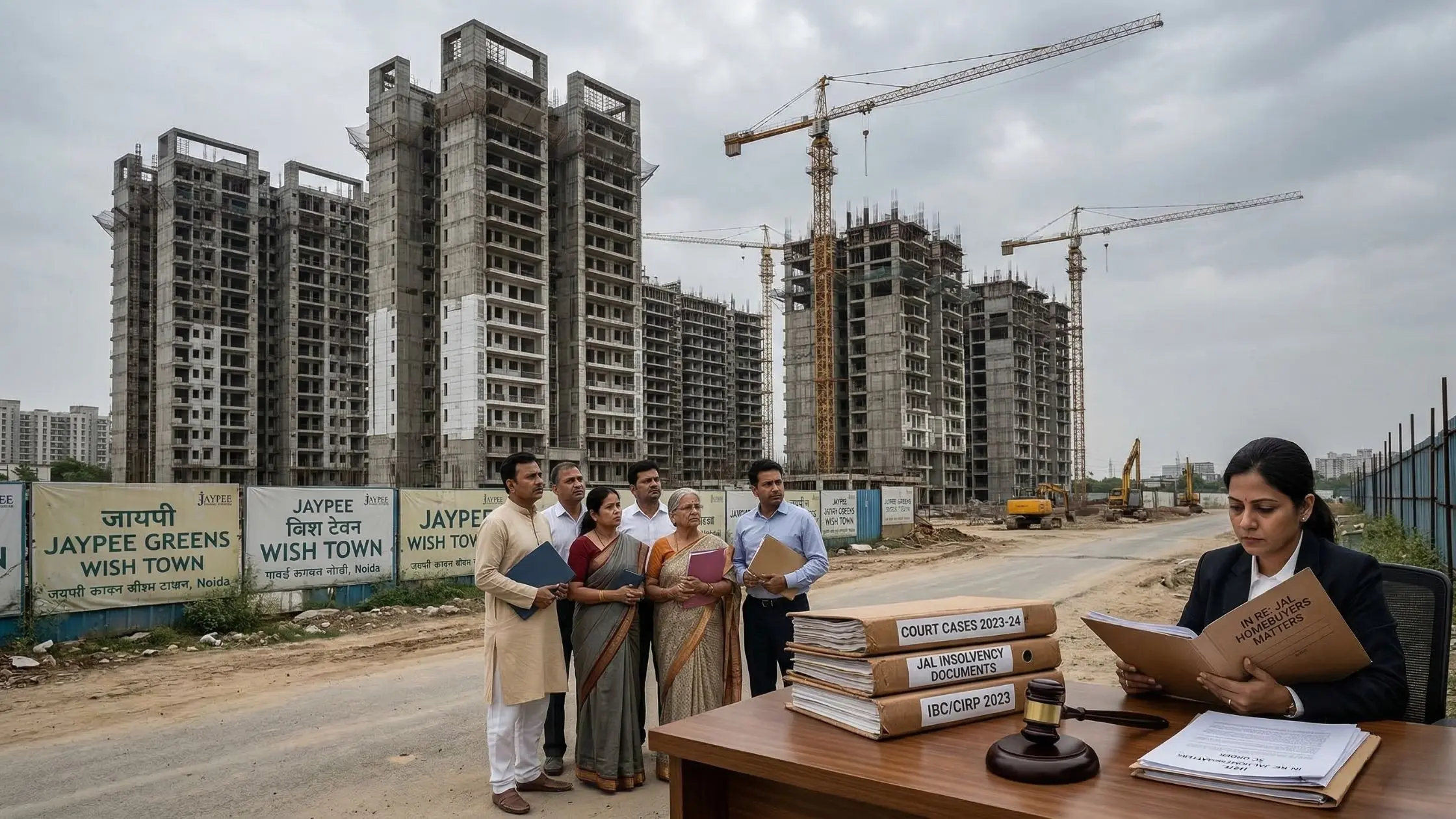
Why the JAL insolvency matters to homebuyers
Jaiprakash Associates' financial distress is not a routine corporate failure. The company's troubles were linked to heavy debt, prolonged project delays, and unresolved concerns around major real estate developments, including Jaypee Wish Town and other large land-linked assets in Noida, Greater Noida, and the Jewar influence zone. This is why the JAL insolvency has significance beyond lender recovery. It directly affects the expectations of homebuyers who have spent years waiting for possession, refunds, or legal clarity.
In practical terms, this case sits at the intersection of three major legal and commercial concerns: insolvency resolution under the IBC, project and promoter obligations under RERA, and the rights of homebuyers as a recognized stakeholder class. That combination makes the matter highly relevant not only for buyers but also for developers, lenders, insolvency professionals, and legal advisors working in the real estate space.
Are homebuyers protected under the IBC?
Yes. The legal position is now settled that homebuyers are treated as financial creditors under the Insolvency and Bankruptcy Code. The Supreme Court in Pioneer Urban Land and Infrastructure Ltd. v. Union of India upheld the constitutional validity of the 2018 amendment and affirmed that amounts raised from allottees have the commercial effect of borrowing, bringing homebuyers within the fold of financial debt.
This recognition is important because it gives homebuyers a formal place in the insolvency process. They are no longer treated merely as disappointed consumers standing outside the main creditor structure. Instead, they can be represented in the Committee of Creditors through an authorised representative and can participate in the insolvency framework in the manner contemplated by law.
That said, legal recognition does not automatically guarantee practical relief. Being a financial creditor strengthens the legal position of allottees, but actual outcomes still depend on the financial condition of the company, the value of assets available, the terms of the approved resolution plan, and the feasibility of project completion. The JAL matter demonstrates this limitation clearly, because admitted claims reportedly stand at Rs. 5.44 trillion while the realizable value under the approved plan is only about Rs. 15,343 crore, implying a very low recovery overall.
What exactly has the NCLT approved?
The approved resolution plan gives Adani Enterprises control over important JAL assets, including substantial land parcels, cement capacity, a stake in Jaiprakash Power Ventures Ltd., and major real estate-linked assets such as Jaypee Greens, Wishtown, Jaypee International Sports City, and hotels in key locations. The structure of the bid, including around Rs. 6,000 crore upfront and the remaining payment within two years, appears to have played a major role in creditor preference.
Vedanta challenged the process and alleged unfairness, but the legal framework under Section 61 of the IBC limits appellate review to specific grounds such as non-compliance with law, material irregularity, or ineligibility of the resolution applicant. In other words, commercial decisions of the Committee of Creditors are not ordinarily reopened simply because another bidder believes its offer was better.
For homebuyers, this means the approval stage shifts attention away from bidding drama and toward implementation questions. The critical inquiry now is not which bidder lost, but whether the approved plan provides a credible path for dealing with unfinished projects, allottee rights, pending claims, and coordination with existing regulatory or legal proceedings.
What should Jaypee homebuyers examine now?
Homebuyers affected by the JAL insolvency should now move from headline reading to document-based analysis. The first question is whether their specific project is directly covered, indirectly impacted, or only commercially connected to assets that form part of the approved resolution structure. Not every buyer-facing issue is resolved merely because the parent company or related entity enters or exits a formal insolvency stage.
The second issue is treatment under the resolution plan. Buyers should examine whether the plan addresses possession timelines, project completion commitments, refund structures, treatment of delayed claims, and the position of pending litigation. Where thousands of allottees are involved, the difference between broad asset transfer language and concrete implementation obligations can become decisive.
The third issue is representation. Since the IBC framework recognises homebuyers as financial creditors through class representation, it becomes important to assess whether allottee interests were adequately represented and whether stakeholder communication was sufficient throughout the process. The legal architecture gives homebuyers a seat in the process, but the quality of participation often determines the usefulness of that seat.
How do RERA and IBC work together?
One of the most misunderstood aspects of real estate insolvency is the relationship between RERA and the IBC. The Supreme Court in Pioneer Urban made it clear that the two statutes must be read harmoniously, though the IBC will prevail in case of direct inconsistency. This means RERA does not disappear from the picture simply because insolvency proceedings are underway.
RERA continues to matter for promoter disclosures, registration obligations, project-level compliance, and delay-related grievances. It also remains relevant as a factual and regulatory framework for understanding what went wrong in a project and how promoter conduct should be assessed. However, once insolvency is triggered and especially once a resolution plan is approved, stakeholder claims and outcomes become heavily shaped by the binding force of the insolvency process.
For this reason, any serious legal analysis of stalled real estate projects must avoid a silo approach. A buyer's position cannot be understood only through RERA orders or only through insolvency headlines. It requires a combined assessment of allotment documents, project status, RERA filings, insolvency proceedings, creditor voting, and the final structure of the approved plan.
The larger lesson from the Jaypee homebuyer crisis
The Jaypee/JAL case is a reminder that real estate insolvency is never only about balance sheets. It is about people who booked homes in expectation of possession, families whose savings remain blocked, and projects that became trapped between financing failure and delayed execution. That is why this matter carries both legal significance and public credibility implications for the sector.
The law has evolved meaningfully by recognizing homebuyers as financial creditors and by allowing them representation within the insolvency framework. Yet the JAL resolution also shows that legal status alone does not cure years of project delay or ensure smooth recovery. Real relief depends on implementation, asset viability, project-level execution, and the ability of the approved plan to translate paper rights into tangible outcomes.
For Jaypee homebuyers, the next phase is therefore more important than the approval headline itself. The central question is whether the resolution process will now result in visible project movement, a clearer route to possession or settlement, and a more credible treatment of allottee interests than what has been seen over the long history of this crisis.
Conclusion
The NCLT approval of Adani's resolution plan is a major legal milestone in the JAL insolvency, but it is not the end of the homebuyer story. For allottees, the focus must now shift to implementation, project coverage, treatment under the resolution plan, and the continuing interplay between RERA rights and insolvency outcomes. In the coming months, the real measure of success will be whether the process produces meaningful delivery for homebuyers rather than only a technically complete insolvency resolution.