
Introduction
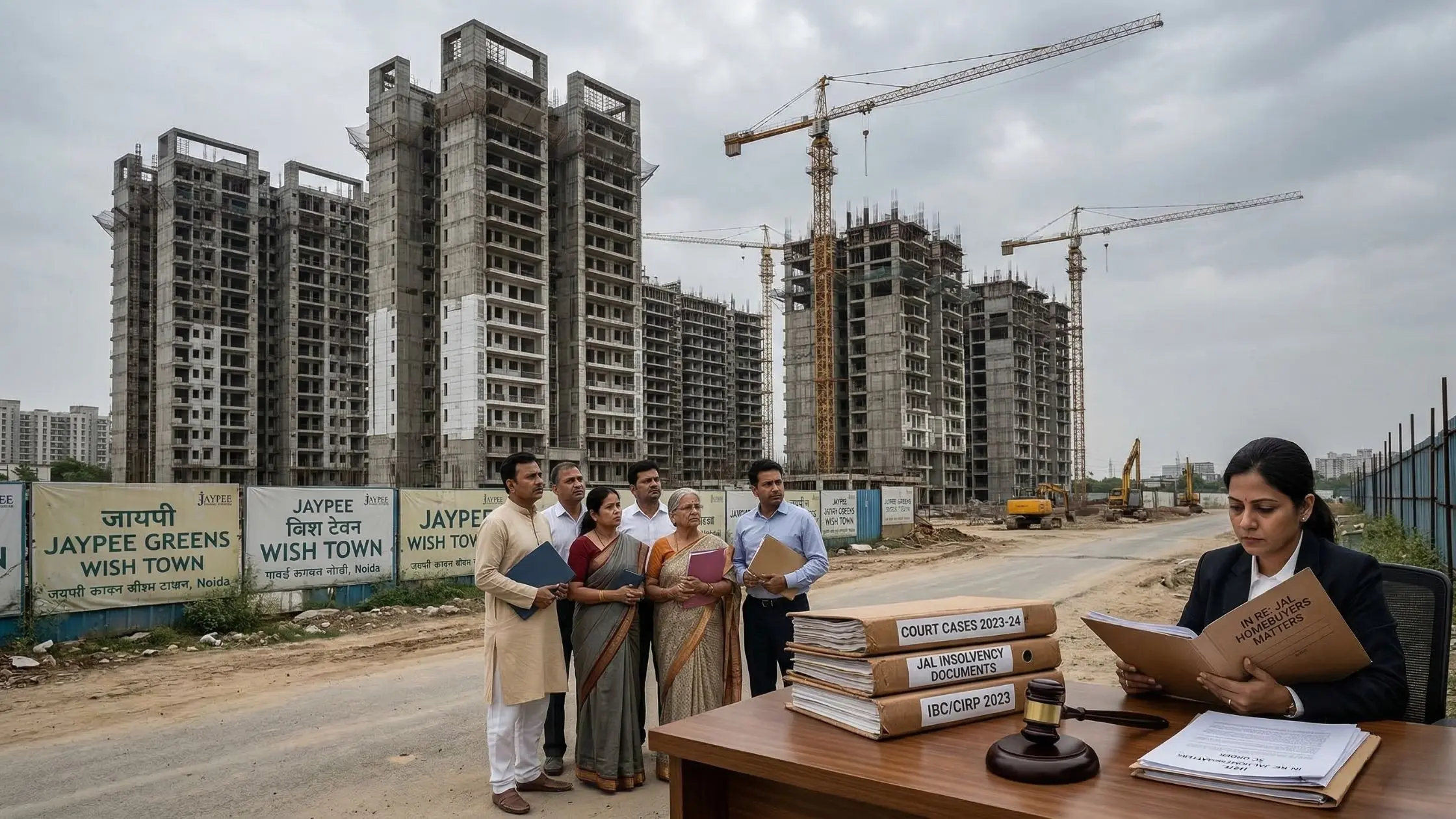
Twenty-five thousand families paid instalments — some for fifteen years — for apartments they never received possession of. They trusted two separate legal frameworks designed specifically to protect them: RERA in 2016, and then IBC when that first line of protection collapsed. In February 2026, India's Chief Justice publicly questioned whether RERA should exist at all. One month later, NCLT Allahabad closed the Jaypee insolvency by approving a ₹14,535 crore resolution plan — at a recovery rate of 26 paise on the rupee. Both verdicts arrived on schedule. Both arrived too late.
Two Laws, One Broken Promise
India built RERA to prevent the problem. Then built IBC to fix it when prevention failed. The Jaypee-Adani case is the most documented instance of both laws being tested simultaneously on the same victims — and the verdict from both processes makes uncomfortable reading for anyone who sits on a board, a regulatory authority, or an audit committee.
RERA, passed in 2016, was architecturally serious. It mandated project registration before sales commenced. It ring-fenced 70% of homebuyer collections in a dedicated, project-specific escrow account. It assigned defined adjudicating timelines and made promoters personally liable for delays and structural defects. On paper, it was among Asia's most buyer-protective real estate laws.
IBC, passed the same year, was designed for the aftermath — when companies collapsed under the weight of debt they could not service. Its promise was speed, certainty, and value maximisation for creditors. By 2018, the Supreme Court recognised homebuyers as financial creditors under IBC, formally giving them a seat at the resolution table.
Both frameworks existed. Both applied directly to Jaypee. And 25,000 families still waited.
RERA's Architecture Was Right — Its Governance Was Not
I want to draw a precise distinction here, because it shapes everything about how this problem gets fixed.
RERA did not fail because the law was poorly designed. RERA failed because the governance infrastructure meant to enforce it was captured — gradually, structurally — by the same ecosystem it was created to regulate.
This is not a conspiratorial claim. It is an institutional incentive analysis. RERA chairpersons and members are appointed by state governments — the same governments that maintain political and financial proximity to large real estate developers. A retired IAS officer navigating a state-controlled post-retirement appointment ecosystem carries a structural incentive to avoid direct confrontation with politically significant builders. Over time, that incentive reshaped institutional behaviour. The 70% escrow mandate was honoured in filings and quietly violated in practice, with minimal independent audit or enforcement. Extension requests were routinely granted. Homebuyers arriving for dispute resolution found timelines that rivalled the construction delays they had come to complain about.
The Appointment Problem Nobody Discusses in Regulatory Circles
The Supreme Court did not arrive at its February 2026 observation accidentally. Chief Justice Surya Kant, sitting with Justice Joymalya Bagchi, was unambiguous. He said homebuyers were "completely depressed, disgusted and disappointed." He said the institution was doing nothing "except facilitating builders in default." And he said — precisely — "Better abolish this institution, we don't mind that."
That is not a technical legal observation. That is a statement of institutional betrayal delivered by India's highest court after watching the same pattern repeat, case after case, state after state, for nearly a decade.
The CBI investigation ordered into the DLF Primus project in Gurugram — where the state RERA authority had remained conspicuously inactive despite documented homebuyer complaints — confirmed in practice what regulatory scholars have long named in theory: a regulator that begins serving the regulated rather than the public. The appointment mechanism was the structural enabler. Until it changes, no amendment to RERA's substantive provisions will produce a different outcome.
When RERA Failed, IBC Was Supposed to Step In
Jaiprakash Associates Limited (JAL) was formally admitted into insolvency in June 2024 after ICICI Bank filed a default petition. Total admitted claims stood at ₹57,185 crore — one of the largest Corporate Insolvency Resolution Process (CIRP) proceedings in Indian corporate history. On March 17, 2026, NCLT Allahabad approved Adani Enterprises' resolution plan worth ₹14,535 crore.
Let those numbers sit for a moment. ₹57,185 crore in claims. ₹14,535 crore recovered. A haircut of over ₹41,800 crore — a recovery rate of approximately 26.8%.
Now consider what Adani acquired for that price: 4,000 acres of prime land adjacent to the upcoming Jewar International Airport, 6.5 MTPA of cement capacity, a 24% stake in Jaypee Power Ventures, 867 premium hotel rooms across Delhi, Agra, and Mussoorie, and the Buddh International Circuit. For reference — in 2017, UltraTech paid ₹16,189 crore for just JAL's cement plants alone, at three times the capacity. That was nine years ago, in 2017 rupees. These are not accusations. They are the facts that the courtroom drama consistently drowned out.
The CoC, NARCL, and the Accountability Vacuum
Here is where governance enters the narrative — and it enters uncomfortably.
Vedanta submitted a revised bid of ₹17,926 crore — approximately ₹3,391 crore higher than Adani's approved plan. In September 2025, Vedanta had emerged as the higher bidder in the challenge auction. Yet the Committee of Creditors (CoC), in which NARCL — a government-backed entity — held approximately 86% of voting rights, voted 93.81% in favour of Adani.
The stated commercial rationale is coherent. Adani offered ₹6,000 crore upfront with full payment within two years, against Vedanta's back-loaded five-year schedule. Adani also accepted the Sports City litigation risk unconditionally — which other bidders would not. When banks and NARCL need stressed assets off their books, speed and certainty carry legitimate weight. I understand that logic. I even respect it.
But here is what I cannot set aside. A government-controlled institution held 86% of the vote in a process covering assets worth multiples of the winning bid — and the decision was made entirely behind closed doors, with no public rationale published. Anil Agarwal of Vedanta claimed he had written confirmation that Vedanta had won, before the decision was apparently reversed. Whether that claim has merit or not, the opacity is itself a governance problem. When outcomes are this large and this irreversible, "the CoC exercised business judgment" is not adequate public accountability. It is a vacuum dressed in legal language.
What the Board Was Actually Responsible For
This is the section I most want board members, CAs, and CS professionals to read carefully — because the Jaypee failure did not begin in June 2024 when ICICI Bank filed its petition. It began years earlier, inside boardrooms, in the silence between questions that were never asked.
Section 166 of the Companies Act places fiduciary obligations on every director — including independent directors — to act in the interests of the company and all its stakeholders. In a real estate developer, homebuyers are the primary external stakeholders. Their money is legally mandated to sit in a project-specific escrow account. Verifying that mandate is not management's responsibility alone. It belongs to the board.
The Enforcement Directorate arrested JAL's Managing Director Manoj Gaur in November 2025 in a ₹12,000 crore money laundering case, alleging that homebuyer deposits were systematically diverted to unrelated group entities. If those allegations are proven, homebuyers were not merely victims of construction delays or market downturns. They were victims of a deliberate, board-level decision to redirect their money. That decision either received board approval — or it was never questioned. Either scenario is a governance failure of the same severity.
Every independent director on a real estate developer's board must be asking, at every quarterly meeting, three non-negotiable questions. First: what is the current escrow balance relative to outstanding construction costs, independently verified — not self-reported by management? Second: what is the gap between collections received and physical construction progress achieved? Third: what RERA complaints and outstanding litigation exist across all registered projects, and does the board have direct, audited visibility into resolution timelines?
If any answer relies entirely on management representation without independent verification, the board is not governing. It is assuming. And in real estate, assumption is how 25,000 families end up waiting fifteen years.
Three Stakeholders Who Had No Voice in Court
The Adani-Vedanta courtroom drama generated weeks of coverage. The three groups who lost the most received almost none.
Equity shareholders received exactly zero. The NCLT-approved resolution plan cancelled all pre-CIRP equity shares, preference shares, convertible instruments, and warrants for nil consideration. On the last trading day before approval, JAL's stock was at ₹2.42. Retail investors who held at the historical par value of ₹10 lost everything — legally, cleanly, within the framework of the law.
Fixed deposit holders — largely middle-income savers who trusted the Jaypee brand — had been waiting for repayment since JAL began defaulting on FDs years before formal insolvency was filed. They sit outside the secured creditor waterfall. With recovery covering barely a quarter of secured claims, these depositors face near-total impairment.
Homebuyers — the 25,000+ families who paid into Jaypee Greens, Wishtown, and the Yamuna Expressway projects since as far back as 2009 — now have possession timelines extending to 2028 and beyond. The Adani resolution plan allocates approximately ₹2,074 crore toward admitted homebuyer claims of roughly 5,000 buyers across JAL's projects, offering a choice between possession within two years or a refund. That is a genuine structural improvement. But it arrives after fifteen years of waiting.
Three distinct classes of ordinary people. One irreversible outcome. And the courtroom's attention went to the conglomerates.
What Genuine Reform Requires — Beyond the Courtroom
The IBC Amendment Bill 2025, passed by the Lok Sabha on March 30, 2026, introduces real structural improvements. A mandatory 14-day rule for NCLT admissions targets promoter delay tactics directly. New IBBI Regulations 16C and 16D introduce sub-class facilitators for homebuyers in large proceedings, ensuring buyers have structured representation without navigating complex legal hearings individually. Regulation 4E now permits possession handovers during the CIRP itself, with CoC approval. These are meaningful reforms — they address the resolution process.
They do not address the origination failure.
Three reforms are still required for RERA to function as the law originally intended. First, appointment processes must be depoliticised. RERA chairpersons should be appointed through an independent search process with mandatory judicial representation — on the model of SEBI's search committee structure. A regulator whose appointment depends on the political ecosystem that benefits from developer goodwill cannot, institutionally, be fearless.
Second, escrow compliance must shift from self-reporting to mandatory independent audit. A RERA-empanelled chartered accountant — with no existing relationship to the developer — should certify escrow balances quarterly, with that information publicly accessible on state RERA portals in near real-time. This change costs nothing legislatively. It requires only political will.
Third, promoter and director personal liability for RERA violations must carry disqualification consequences — not just monetary fines. Fines paid from project funds protect no one. Personal disqualification, on the Section 164 model under the Companies Act, would fundamentally change the boardroom calculus of any developer considering fund diversion.
Practical Tips for Homebuyers
The legal framework has improved. But the burden of vigilance still falls substantially on buyers themselves. Here are the actions that actually matter.
- Before signing any agreement, verify the project's RERA registration on your state portal and confirm the escrow account details are publicly disclosed. This is your legal right, and many buyers never exercise it.
- Demand quarterly project update reports from the developer in writing. RERA mandates these disclosures. Documenting every communication creates the paper trail that matters if proceedings are initiated later.
- If your project is already delayed, file a RERA complaint and simultaneously monitor whether insolvency proceedings have been initiated against the developer. Under IBC, you are a financial creditor — but only if your payments are formally documented and claims properly filed.
- In any insolvency proceedings, engage with the homebuyer sub-class representative now mandated under the 2025 IBBI amendments. Your voice in the CoC has a structural channel that did not exist before. Use it actively, not passively.
- If possession timelines have crossed the contracted delivery date, your right to interest at the SBI MCLR rate under RERA is automatic and accrues from the date of default. Do not wait for the developer to acknowledge it.
- Engage a practicing Company Secretary or advocate experienced in both RERA and IBC. In proceedings of this scale, the difference between a documented claim and an undocumented one is the difference between partial recovery and total loss.
My POV
I have sat in boardrooms. I have reviewed project financials. I have asked the questions that management sometimes does not want to answer in a formal meeting. And I want to say something plainly — not as an analyst, but as a practitioner.
The Jaypee case is not exceptional. The scale is exceptional. The mechanism — a highly leveraged real estate developer raising retail money, diverting it progressively, under board oversight that either approved the diversion or refused to investigate it — is a pattern I have seen in smaller forms across multiple geographies. What makes Jaypee distinct is that it was too large for the pattern to stay hidden.
RERA failed not because the law was poor. It failed because the accountability culture the law assumed — inside developer boardrooms, inside regulatory offices, and inside state governments — did not exist where it mattered. IBC stepped in to manage the wreckage, and it did so within its procedural mandate. The 2025 amendments are a genuine course correction. But no amendment can retroactively create the governance discipline that should have operated in 2014 or 2018 or 2022, when the right questions could still have changed the outcome.
The real question is not which conglomerate deserved the distressed assets. The real question is why no independent director inside JAL ever formally placed on record a concern about where homebuyer money was going. Why no audit committee minutes reflect a question about the gap between RERA escrow balances and actual construction disbursements. Why no quarterly board meeting produced a dissent note that said: this does not add up.
Every board meeting where the right question goes unasked is a small governance failure. Enough of those compounding silences, and you get a ₹57,000 crore insolvency, 25,000 families without homes, and a Chief Justice asking whether a ten-year-old regulator deserves to exist.
The Supreme Court said the quiet part out loud. The IBC amendment corrected some structural gaps. Now the remaining work belongs inside every boardroom in India — in the quality of the questions asked, the independence of the answers demanded, and the willingness of every director to understand that their fiduciary duty runs to every stakeholder who trusted the institution they govern.
That culture cannot be legislated. It has to be chosen.